Bio-Reductive Synthesis Pathway
Uses plant-based phyto-molecules as natural reducing and capping agents completely eliminating synthetic chemicals.
Visionary Leadership for a Better World
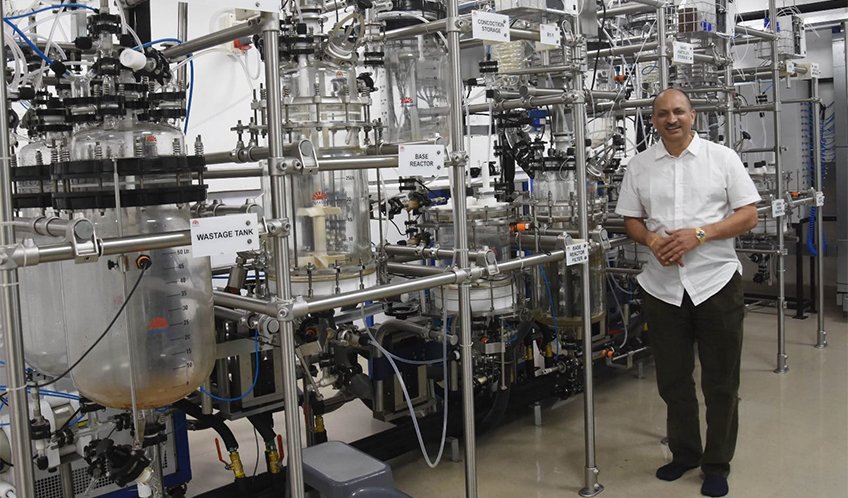
In a historic scientific milestone, Dr. Anantkumar Hegde has engineered the world’s first fully automated Green Nano Reactor, a pioneering system that transforms laboratory-scale nanoparticle synthesis into an industrial-grade, sustainable, and precision-controlled process.
This innovation establishes India as a global leader in sustainable nanomanufacturing, marking the dawn of a green industrial revolution in nanoscience.
Until now, nanoparticle production faced fundamental limitations in scaling from lab to industry due to several scientific and engineering barriers:
Thus, for over few decades, scaling nano-synthesis from tabletop experiments to industry scale production has remained one of the most unsolved engineering challenges in nanotechnology.
Dr. Hegde’s Green Nano Reactor overcomes these long-standing barriers by introducing a bio-mimetic, fully automated, and environmentally neutral reactor system designed around green chemistry principles.
How the reactor transforms lab-scale nano synthesis into industrial reality.
Uses plant-based phyto-molecules as natural reducing and capping agents completely eliminating synthetic chemicals.
AI-integrated sensors monitor in real time, maintaining molecular-level precision during particle nucleation and growth.
Employs continuous-flow design to control nucleation kinetics, preventing agglomeration and ensuring uniform nanoparticle morphology.
Modular architecture allows scaling from millilitre laboratory volume to unlimited production without compromising stability or purity.
The entire process is carbon-neutral, solvent-free, and biodegradable, leaving zero hazardous residues in effluents.
Achieves particle size uniformity, with crystalline precision and enhanced biocompatibility.
The only operational large-scale green nano synthesization reactor integrating phytochemical pathways with industrial automation.
Positions India as the epicenter of sustainable nanomanufacturing, setting benchmarks for environmental ethics and technological sovereignty.
Enables mass production of non-toxic nano-materials for pharmaceuticals, nutraceuticals, cosmetics, agriculture, and diagnostics.
Every reaction cycle neutralizes its own carbon footprint through green synthesis routes, aligning with UN Sustainable Development Goals